Short answer: galvanics turns the soft disc your music was cut into, the lacquer, into hard metal copies that can press thousands of records. Each copy is the mirror image of the one before, a bit like a stamp and the mark it leaves. There are two ways to do it. One-step is quick and suits short runs. Three-step keeps a spare "mother" part, so new stampers can be made without cutting your music again.
Why is galvanics needed at all?
Imagine you draw a picture with your finger in soft clay. It looks great, but if you press it onto a hundred sheets of paper, the clay squashes and your drawing is gone.
The lacquer is like that clay. When your music is cut, a sharp needle carves a long, wiggly groove into a soft coating. It holds every sound perfectly, but it is far too soft to press records with: one press and it would be ruined.
So we make a metal copy of it, which is strong enough to press record after record. Making that metal copy is galvanics. It is also called electroplating, because it uses electricity to grow a thin skin of metal, mostly nickel, on top of the lacquer.
How does the metal "grow"?
First the lacquer is cleaned and given a very thin silver coat, so electricity can run over it. Then it goes into a bath of liquid with nickel in it. A gentle electric current makes tiny bits of nickel stick to the surface, one layer at a time, until they form a solid metal disc.
When the metal is peeled off, it has the exact shape of the groove, but turned inside out. Where the lacquer had a valley, the metal has a ridge. Think of pressing your thumb into play-dough: the dough shows a hollow, your thumb is the bump.
What are the father, the mother and the stamper?
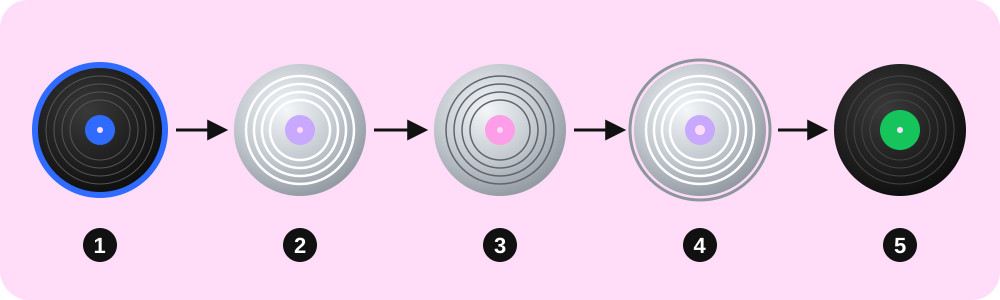
Because every copy flips the shape, the parts are named like a family:
- The father. The first metal copy, grown on the lacquer. It has ridges instead of grooves. Growing it damages the lacquer, so each lacquer can only make one father.
- The mother. A copy grown on the father. Flipped again, so it has grooves, just like the lacquer. You could even play it. Several mothers can be made from one father.
- The stamper. A copy grown on the mother. Flipped once more, so it has ridges again. This is the part that goes into the press: the hot vinyl is squeezed between two stampers, one for each side, and the ridges press the grooves into your record.

Do stampers wear out?
Yes. Every time the press closes, a little bit of the stamper's surface is worn away, like the sole of a shoe. A stamper presses around a thousand records before it should be replaced. After that the sound can get noisier.
That is why the mother matters: when a stamper is tired, a fresh one is grown from the mother, and your records keep sounding as they should.
What is the difference between one-step and three-step?
- One-step: the father itself becomes the stamper. There is no mother. It is faster and cheaper, and it is fine for a short run. But when that stamper wears out, or when you want to press the record again later, there is nothing left to grow a new one from: the music has to be cut into a new lacquer.
- Three-step: father, mother, then stampers. It takes a little longer, but you get a mother that can give you new stampers whenever you need them. That is the right choice for bigger runs and for any record you hope to press again.
Small runs can use one-step without any problem. If you think your release could sell out and come back, three-step is the safer bet. We tell you which one fits when we quote your project.
Why does it matter to you?
Because the stamper is the last step before your record exists, any tiny fault in the metal ends up on every copy. A good galvanics shop works very clean, checks each part under a microscope, and makes sure the groove sits exactly in the centre so the record does not wobble.
You never see the metal parts, but you hear them. The best way to check them is your test pressing: the first records pressed from your stampers. For the full journey from your file to the finished record, read how a vinyl record is made.
FAQ
What is galvanics in vinyl pressing?
It is the step that turns the soft lacquer your music was cut into into hard metal parts, by growing nickel on it with electricity. The last of those parts, the stamper, presses your records.
What is a vinyl stamper?
A metal disc with ridges instead of grooves. Two stampers, one per side, sit in the press and squeeze the hot vinyl into a record. Each one presses around a thousand records before it is replaced.
Why is it called father, mother and stamper?
Because each part is grown on the one before and is its mirror image: the father has ridges, the mother has grooves again, and the stamper has ridges again, ready to press.
Should I choose one-step or three-step?
One-step is quicker and cheaper and suits short runs. Three-step keeps a mother, so new stampers can be made for a long run or a re-press without cutting your music again. We advise which one fits your run.
Planning a release? Tell us the format, quantity and finish in our configurator and we will reply with a quote by email.